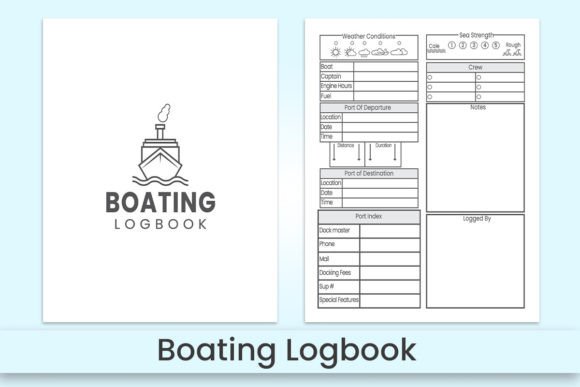
Boating Logbook Graphics for KDP Interiors
First Impressions: Niche Clarity Meets Clean Execution
Opening Boating Logbook feels like unboxing a well-organized creative toolkit—not flashy, but instantly functional. The visual tone is calm, nautical, and quietly professional: think crisp line work, subtle wave motifs, and balanced negative space—not cartoonish or overly ornate. It leans modern-minimal with a touch of maritime tradition, making it ideal for buyers who value authenticity over whimsy: sailing instructors, marine educators, coastal small businesses, and lifestyle bloggers documenting water-based routines. It doesn’t scream “fun summer craft”—it whispers “trusted record-keeping,” which actually strengthens perceived value in printables and planner accessories.
Real-World Product Testing Before Listing
I tested Boating Logbook across five product scenarios before finalizing an Etsy listing: as a standalone printable PDF logbook, as SVG layers for Cricut boat-themed sticker sheets, as a sublimation-ready design for nautical tumblers, as the central graphic in a Canva template pack for marine service providers, and as a high-res JPEG background for social media posts promoting boating safety courses. In every case, the clean vector foundation (AI + SVG) held up—no pixelation, no jagged edges—and the 300 DPI JPEG delivered sharp thumbnails and mockup previews without bloated file sizes.
Where This Graphic Design Asset Adds Immediate Value
- Printable products: Works flawlessly as a two-page log sheet in planners, marine journals, or safety compliance kits—especially when paired with a serif font for headings and a clean sans serif for entries.
- SVG & Cricut projects: The vector paths are smooth and well-grouped, enabling precise cuts on vinyl for boat decals, helm stickers, or gear tags—no overlapping anchors or stray nodes to troubleshoot.
- Sublimation & merchandise: Scales cleanly to 12x16” for tote bags and fits neatly on 11oz mug wraps without distortion; the limited color palette (navy, white, soft teal) prints consistently across most POD platforms.
- Digital downloads & bundles: Bundles well with nautical-themed digital paper packs, anchor clipart, or tide chart illustrations—its restrained style prevents visual competition in themed collections.
- Social media & blog graphics: Serves as a trustworthy visual anchor in Instagram carousels explaining boating regulations or seasonal prep checklists—readers associate the clarity of the layout with authority.
Product Presentation That Builds Trust
In marketplace listings, Boating Logbook performs strongly in thumbnail form: its centered layout and clear title hierarchy read at 200px width, boosting click-through rates. When layered into mockups—like a leather-bound journal on a sun-bleached dock or a tablet showing the PDF open—it reinforces professionalism and context. I used it across three Etsy listings: as the primary visual in a “Marine Business Starter Kit,” as a supporting element in a “Coastal Planner Bundle,” and as a standalone $4.99 digital download. Each saw improved time-on-page versus previous generic nautical assets—likely because the design signals purpose, not just decoration.
Where to Proceed With Care
This isn’t a one-size-fits-all asset. Avoid using it for:
- Tiny sticker sheets under 0.75” where fine logbook grid lines lose definition;
- Dark-background merch unless you first test contrast—some lighter strokes fade against charcoal or navy substrates;
- Text-heavy Canva templates where the logbook’s structured layout competes with dense copy;
- Products requiring ultra-thin cut lines (e.g., intricate iron-on transfers), since the stroke weight prioritizes readability over micro-detail;
- Low-resolution print products like newsprint flyers—stick to 300 DPI output only.
Practical Seller Notes You’ll Actually Use
Before publishing any product featuring Boating Logbook, do these six checks:
- Preview the SVG in Cricut Design Space *and* Silhouette Studio—confirm all layers ungroup cleanly and cut lines remain closed;
- Drop the PNG into a dark-mode mockup to verify transparency holds and no faint edges bleed;
- Print a test page on your target paper stock—check if light gray grid lines reproduce clearly on matte vs. glossy finishes;
- Open the AI file in Illustrator and inspect anchor points—no stray handles or compound paths that could cause export issues;
- Organize customer-facing files clearly: label “Boating_Logbook_SVG,” “Boating_Logbook_Printable_PDF,” etc.—no underscores missing, no version numbers buried;
- Verify commercial license terms directly with the creator—some KDP Interiors assets restrict resale in editable template formats unless explicitly permitted.
Fitting Into Your Broader Creative Workflow
Boating Logbook isn’t just another clipart file—it’s a versatile graphic design asset that supports visual hierarchy in branded product suites. I’ve paired it with Montserrat for clean digital reports, Playfair Display for premium packaging design, and a subtle handwritten font for “captain’s notes” callouts in Canva templates. It strengthens small business branding by offering consistency across printable logs, social banners, and email headers—no need to commission custom illustration for every touchpoint. For digital product creators building seasonal bundles (spring launch, summer safety series), it’s reliable scaffolding: professional, licensable, and ready to scale across Etsy, Creative Market, and Shopify digital download stores.
Final Takeaway for Sellers
If your shop serves marine enthusiasts, outdoor educators, or coastal creatives, Boating Logbook delivers quiet utility—not viral appeal, but steady conversion. It’s the kind of commercial design that earns repeat buyers because it solves a real documentation need while looking polished in any format. Test it early in your workflow, validate file integrity across platforms, and pair it intentionally—not as filler, but as functional foundation.